
Organization
UCSD Jacobs School of Engineering
Category
Academic
Type
Engineering
Year
Mar 2025 – Jun 2025
Location
Savannah, Georgia
Status
Completed
Focus
Mechanical design, CAD modeling, Prototyping
Led design of a CAD-modeled telescoping scissor-arm mechanism using worm-gear actuation to deliver a payload under strict size and material constraints.
Project Overview
Project Name
SE3 Design–Build Project — Telescoping Payload Delivery System
Client / Organization Background
The SE3 design–build project was part of a structural engineering design course focused on translating conceptual engineering ideas into functional mechanical systems. Students were required to design and prototype a mechanism capable of delivering a small payload to a specific location while working within strict physical and material constraints.
The project emphasized practical engineering skills including CAD modeling, mechanical design iteration, and systems integration.
Objective
Design a compact mechanical system capable of delivering a payload to a defined target location using a controllable extension mechanism while meeting strict constraints on size, cost, and structural feasibility.
Scope
• Develop a fully modeled mechanical system using CAD tools
• Design a mechanism capable of extending toward a target location
• Integrate a motor-driven actuation system
• Maintain strict compliance with dimensional and material constraints
• Ensure the mechanism could deliver the payload reliably and accurately
Key Details
Team Size
4 engineers
Project Duration
One academic design cycle
Engineering Challenge
Deliver a payload (Poké Ball) to a fixed target using a compact mechanical deployment system.
Primary Design Constraints
• Limited structural materials
• Restricted cost budget
• Maximum size limitations
• Mechanical reliability requirements
Primary Software
• SolidWorks
• AutoCAD
Mechanical Systems Integrated
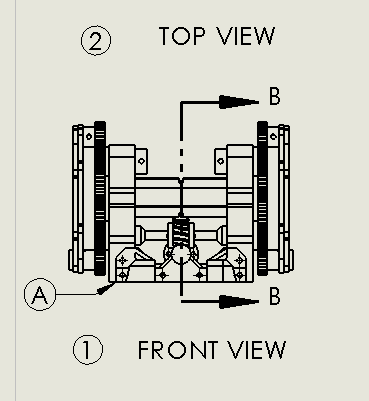
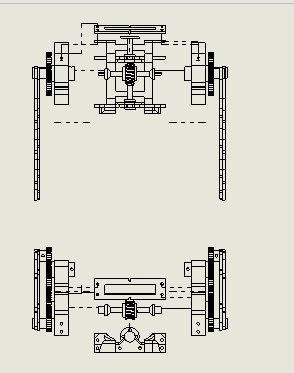
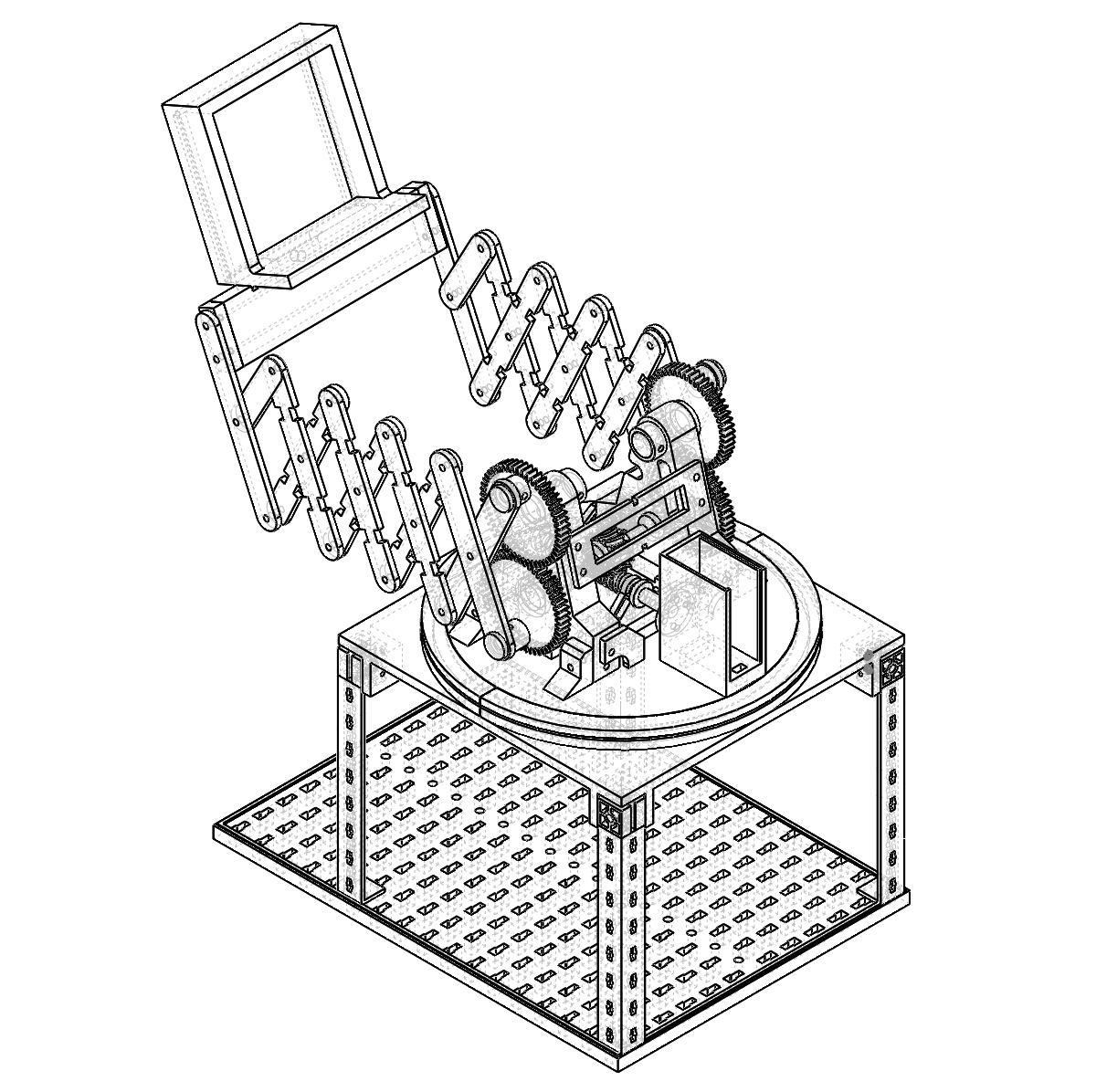
• Telescoping scissor-arm mechanism
• Worm gear drive system
• Motor-driven actuation
• Structural spacer assemblies
• Payload release mechanism
Design Approach and Execution
Concept and Vision
Design Philosophy
The project required balancing mechanical simplicity with controlled motion and structural stability. Our design focused on creating a reliable extension mechanism capable of reaching the target while maintaining stability under constrained material and geometric limits.
A telescoping scissor-arm configuration was selected because it provided a compact footprint when collapsed while enabling significant reach when extended.
Key Engineering Principles
Controlled Mechanical Advantage
Use gear-driven actuation to regulate extension speed and torque while maintaining precision.
Structural Efficiency
Design components to maintain rigidity while minimizing unnecessary material usage.
Compact Deployment
Ensure the system remained within dimensional constraints when retracted.
Design Inspiration
The extension system was inspired by scissor-lift mechanisms commonly used in industrial lifting equipment, adapted to operate at a smaller scale for precise mechanical deployment.
Execution
Phase 1 — Concept Development
Generated multiple mechanical concepts capable of delivering a payload to the target.
Evaluated possible solutions including lever arms, rotating systems, and telescoping mechanisms.
Selected a scissor-arm telescoping mechanism due to its ability to extend significantly while maintaining compact storage dimensions.
Phase 2 — CAD Modeling and System Integration
Developed a complete mechanical model consisting of more than 30 individual components and eight integrated subassemblies.
Used SolidWorks to model the full extension mechanism, including structural members, connection joints, and motion components.
AutoCAD was used to refine dimensional layouts and mechanical alignment.
Phase 3 — Mechanical Actuation Design
Integrated a worm gear drive system connected to a motor to control extension of the telescoping mechanism.
The worm gear configuration provided several advantages:
• Increased torque transmission
• Controlled extension speed
• Mechanical stability under load
Spacer assemblies and structural joints were designed to maintain alignment throughout the extension cycle.
Phase 4 — System Testing and Iteration
Performed iterative design adjustments within the CAD environment to ensure the system could reach the target location without exceeding dimensional constraints.
Evaluated mechanical clearances and structural stability during the extension process.
Optimized component layout to balance mechanical strength and material efficiency.
Results and Outcome
Outcome
Functional Mechanical Design
Delivered a fully modeled telescoping payload delivery system capable of reaching the target location under strict dimensional constraints.
Complex Systems Integration
Successfully integrated multiple mechanical systems including gear drives, extension arms, and structural assemblies.
Advanced CAD Modeling
Developed a complete mechanical design consisting of 30+ components and eight subassemblies.
Engineering Problem Solving
Demonstrated the ability to translate theoretical design concepts into practical mechanical solutions.
Credits and Collaboration
Engineering Team
Four-person structural engineering design team
Team Leadership
Design coordination and system architecture led by Thienan Bui
Primary Software Tools
• SolidWorks
• AutoCAD
Course Program
Structural Engineering Design–Build (SE3)
Gallery

More Projects
Continue exploring related work.


No eligible item
No eligible item